Showing posts with label Japanese architecture. Show all posts

Elements of Japanese Gardens


Which garden style you choose, and what it contains, will depend on many things. You'll need to look at the size of the area you have to plant, the climate and conditions in the place you live, and the purpose of the garden. Do you want a retreat from the world, or an open space to enjoy the sun with your family? Do you like to work in the garden, keeping edges trimmed and beds tidy, or would you rather put your plants in and let them grow as they will? The elements of Japanese gardens can be incorporated and adapted to suit whatever style you prefer.

Every Japanese garden relies on the same set of basic features: rocks, water, and plants; buildings, bridges, and walls; lighting and shade; and landscape, whether in miniature or in the land surrounding the garden. In some cases, as in the Zen rock gardens, some of these features are replaced by others. For example, raked sand representing rippling water. In others, certain features are highlighted by the fact of their absence: the inward-facing tea garden makes you aware of the world beyond the garden by ensuring that the outside landscape is entirely hidden.

But the feature that is most important, and is common to all of the garden types, is what makes the difference between an authentic Japanese garden and one that merely uses some of its symbols - the sense that the garden is perfectly suited to where it is and what it contains. As we mentioned before, the rules of design are so deeply buried in tradition that often unless you know exactly what to look for, it's hard to see that a Japanese garden has been "designed" because it may look completely natural. On the other hand, just putting a stone lantern in the middle of your petunia patch won't turn it into a tea garden.

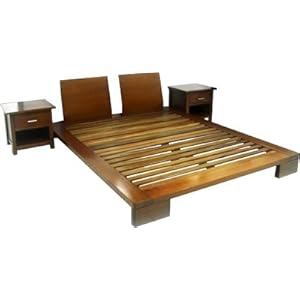
Platform Bed - Japanese Style


A Japanese platform bed is a particular style of bed that is usually lower than the average bed, sitting closer to the ground. Like other platform beds, they don't need box springs because they have solid bases to support any type of mattress. A good, affordable solution, these beds add an elegant feel to any bedroom.

One recognizable characteristic of these beds is its simplistic, uncomplicated style. The style and is supposedly inspired by the Japanese architecture and the design of pagodas.
Although the design looks very basic, these Japanese beds made of solid wood are of high quality and come in various light and dark finishes to complement any modern bedroom.

Whilst unnecessary, some people prefer to purchase tatami mats for use on the bed frame. These straw mats were used traditionally to separate people and objects from the floor - in this case, the 'floor' being the bed base.

The combination of gentle curves with straight, Zen-like lines of a Japanese bed are meant to promote well-being and healing as well as good fortune and prosperity. Lightweight and easy to assemble, the Japanese platform bed is easy to move and makes it convenient for today's contemporary living.


Basically, all materials used in Japanese architecture are found in nature. Eventually, this can be called as 'Organic Architectural Character' which is a part of their tradition originating from long time ago. Part of this architectural character is the by keeping the natural state of the materials or by enhancing their natural state, instead. Using natural materials encompasses the main style of the Japanese architecture.

Bamboo
Traditional Japanese houses use bamboo as fence. Adopting this material to where bamboo is bountiful, we can simply make it as our wall cladding. We can keep all its lovely natural nodes intact and enhance its beauty by coating it with polyurethane or a natural varnish. Or, we can make use of bamboos as material for our chairs and tables, bamboo displays or decorations or just an ornamentation for cabinets, vanity, racks and many more uses.

1. Wood
Japanese make use of wood with its bark on. Though we can adopt it, but don't cut trees just to have it, :->. Unused logs can form a part of our outdoor gardens or interior gardens. Barked woods can also be use in our party wine bars as accent or simply left alone as decoration in our houses.

2. Paper
This Japanese paper as we locally term it here in the Philippines, is made from Mulberry Tree. It is traditionally used for movable partitions.

3. Tatami Mat
It is made up of tightly woven straw bound with cords. It is widely used in Japanese households. It is placed 24 cm from the floor. A step rail is used to comfortably get up onto it.

4. Stone
Ordinarily, it is used in houses of course. Japanese also use this in pathways which are patiently hand laid.

5. Nagare-Zukuri
Japanese term for Gable Roof. It is the basic roof style of ancient and traditional Japanese houses.

6. Chidori Glabes
It is a decoration on eves and roofs which is triangular in form.

About Japanese Gardens

Japanese Gardens are one of the wonders of nature and a true personification of spirituality. A perfect Japanese garden is the epitome of beauty and appearance. Types of Japanese Gardens
There are five different styles of these gardens, mentioned below:
  • Tea Gardens
  • Flat Gardens
  • Natural Gardens
  • Strolling Gardens
  • Sand and Stone Gardens
Japanese Gardens Basics - The Required Items
Like any garden, these gardens require some elements for it to flourish. The most important one is common to all gardens, namely water. Water is reflected upon as a symbol of purity in Japanese gardens. Other common elements include stone, trees, and plants that essentially give the garden its true look. Some people take a step further and add a beautiful waterfall to their garden. It makes the garden look more appealing and breathtaking.
Bridges in particular create a scenic look for a garden. Another good idea is to use lanterns to keep the garden illuminated at night.

Garden Landscape Architecture - East vs. West
If you are looking for a garden that is truly unique in every way, then Japanese gardens would be an excellent choice to pick. I find Japanese gardens fascinating, I have visited Japan twice once in 1998 and again in 2002. Japanese gardens are simple yet amazing, I particularly like the small Japanese gardens and this is what I am going to be writing about here.

Japanese gardens are very much about nature and a natural looking garden is considered to be the 'ideal' garden. So don't add one to your small Japanese garden. You should never create or add something to your garden that nature its self cannot.
Rocks are one of the most common things used in Japanese gardens especially the smaller ones. I love how the Japanese feel that they have to separate there small garden from the outside world. There are basically 5 types of components that should be included in small Japanese gardens.

Rock or Ishi - As I said above rocks are the foundations of Japanese gardens. Water or Mizu - Water is calming and is a great way to make the garden look natural. Plants or Shokobutsu - Plants do play a secondary role to rocks and water in Japanese gardens unlike gardens from other cultures. Like water plants are said to have a meaning in Japanese gardens which is to remind us of each and every season passing away.

Ornaments or Tenkebutsu - lanterns are often used in Japanese gardens particularly smaller Japanese gardens. These ornaments add an added interest to traditional Japanese gardens.
Borrowed or Shakkei - This is usually something from outside the garden. If you have a small garden which is in a sunny location I highly recommend that you look into making a Japanese garden.


About Japanese GardensTea Gardens
About Japanese GardensFlat Gardens
About Japanese Gardens
Natural Gardens

Japanese Architecture - House with Wood Exteriors and Interiors

apanese firm a.un architects are behind this simple yet modern wood exterior / interior house design in Mie, Japan. From the outside in, this unusual innovative house plan is clad in wood and features a down-to-earth look that works wonderfully with its surroundings. Every room offers vistas of sea and sky by virtue of the home’s 30-degree curved design, which is elevated 1.8 meters from street level. Inside this compact yet functional plan, a great upper loft design idea offers an added living space to enjoy with an open-to below view of the main floor. No matter where you are or where you’re looking, the timber gives the house its characteristic organic warmth and a welcoming aesthetic that’s ideal for the family.

timber-home-designs-curved-japanese-house-1.jpg

timber-home-designs-curved-japanese-house-2.jpg

The Japanese concept - Kanjis Concept in Real Estate

Just like the Japanese incorporated Chinese-derived characters in the kanjis, when renting investing property investors needs to be aware where the responsibilities of the tenant start and when they end.

The responsibility of the owner of a real estate property are not transferable to the tenant once the property is rented. The owner is the ultimate party responsible for the property and can share some of these responsibilities with the tenant if the contract is structured properly.

Before we decide to rent a real estate property it is recommended to comply with certain general and economic points that should be avoided.

1) Have the property in habitable condition for use.
2) You are unable to evict tenants before the end of the contract, or extensions if there isn't a breach of contract by the tenant.
3) The liability for damage caused by the real estate to the community is on the owner.
4) The owner hold a responsibility to the other tenants and members of the neighborhood association.
5) You must pay attention and control tenants to comply with the rules of the community of neighbors and caring of real estate property.
6) It is advisable to keep the unit in good condition so that the rental is more feasible. When renting is advisable to invest in paint, review and care of furniture, and appliances
7) The overall costs of real estate correspond to the owner. It is possible to agree with the tenant to take over him, but the control is still the owner responsibility.
9) Spills and other waste coming from improvement jobs in the building are the responsibility of the owner of the real estate.

However, the costs for the owner are deductible (under the conditions that mark the tax) and also enjoys significant rental deductions. - It is advisable to have at least one real estate insurance -multi-hazard and if possible with default rent insurance, which means additional expenses to consider.

Management companies are a viable solution to delegate all the tasks associated with the responsibilities of owning a rental real estate property, although the legal accountability can not be transferred to the management company, the task can. Management companies usually charge a percent of the rent, this expense should be calculated in the property annualized expenses to find out whether the property will yield positive cash flow. Management companies will for the most part handle everything from maintenance of the property to collecting the rent; this type of service allow the investor to produce passive cash flow, thus allowing the investor to emulate the same process as many times as desired.

Although management companies do not eliminate the legality of being a owner, forming a limited liability company can reduce it. Essentially instead of buy real estate investments under ones name, one simply forms a limited liability company and operate the investment under the new entity. This can reduce the risk of losing everything the owner of the property is sued. This is the method used by most big time investors, it allow to diversify the risk among different legal entities thus limiting the financial damage that any single entity can suffer. If you already own real estate investment properties under your name there might be tax implications to transfer them to a new entity, therefore it is better to just buy the real estate under the name of the entity that will hold it for the projected time of the investment.

Insurance can also provide some protections in the event of damages caused to other from resulting from the property. Insurance comes in various forms and they offer different protection levels, but some insurance companies offer coverage people injured in the property.

Delegation in the form of management companies and protection in the form of limited liability companies and insurance can provide a robust model from implementing an investment strategy that protects the investment and allow for a remote management architecture. Although one can not be protected from all events the remaining risks are very manageable and rarely encountered. This is one of the advantages of investing in real estate in a developed country where laws are matured and professional companies exist to perform otherwise tedious tasks. At the same time the enforceability of laws in developed countries is more exist, thus making investors more liable for mishandled responsibilities, but that's what give credibility to the market, showing that laws are enforced fairly and consistently. The real benefit of investing is realized when outcomes can be predictable and a clear separation of responsibilities is understood by everyone.

Lastly no matter how much you delegate your responsibility as a real estate owner always stay informed of law changes and review and audit the contract and work of the management company to ensure, after all it in your best interest to do so. Also review the insurance policy once a year to ensure recent circumstances are not leaving exposed to unnecessary risks.


The Japanese concept - Kanjis Concept in Real Estate

It can be easy to imagine that all Japanese bathtubs are basically the same but the truth is that there are quite a few different types of Japanese baths available.

Japanese bathtubs offer a different experience than a typical western bathtub. While western bathtubs are meant to simply help a person get clean, Japanese tubs are designed to hold hotter water and are meant for soaking after the bather is already clean. Japanese bathtubs are usually installed next to other bathing apparatuses. Some people might choose to install a standing shower next to the Japanese bathtub. Others might choose to imitate the traditional Japanese bathing experience, with a small hand held shower head, a stool and a drain.

Traditional (original) Japanese baths were always constructed from wood. This is because the wood was supposed to enhance the therapeutic and restorative value of the bath itself. These types of Japanese bathtubs can still be found in spas or at hot springs as well as in some people's homes. Modern Japanese bathtubs, however, are made out of the same materials used for western bathtubs: ceramics, stainless steel, fiber glass, porcelain, etc.

With wooden Japanese tubs, the water is rarely drained from the tub between uses. This is because the actual washing is done outside of the tub so the water does not get dirty the way it would if it was used for regular washing. These tubs usually come with a fitted cover to keep the heat from escaping and to keep other objects from landing in the water.

The Sento is another type of Japanese tub. These Japanese tubs are communal and are sometimes referred to as bath houses. These Japanese bath get separated into two areas: one for men and one for women. The washing is done in a separate area and the bathers will usually sit in the Japanese bathtubs without any sort of clothing or covering though a small wash cloth can be used to cover a bather's private areas.

An Onsen is a type of Sento. These are Japanese tubs which get their water directly from natural hot springs. The Japanese culture dictates that these waters are very valuable for their healing and purifying properties so these outdoor Japanese bathtubs are very popular-far more popular than the Sento which is seeing a decline in patronage.

Obviously a Japanese home is not going to have a Sento or an Onsen within its walls. In fact, the Japanese home is more likely to have a Japanese bathtub that is constructed out of western bathtub materials (previously mentioned). Some Japanese families build their bathrooms to look just like western bathrooms-with long and narrow Japanese tubs sitting at one end of their bathrooms and a separate area for actual washing to take place (this area is sometimes enclosed or also constructed out of bathtub materials used in the west).

Japanese bathtubs offer a wonderful way to relax and soak without having to worry about washing. Is it any wonder that Japanese bathtubs are becoming more and more popular throughout the western world?


Japanese Bathtubs - The Different Types

Embassy Of Finland In Tokyo | World Architecture

Embassy Of Finland In Tokyo | World Architecture
"The most important is to create an image of Finland. The Embassy must represent Finland in the right way."

Japanese Architecture - New restaurant near to mountain Fuji

Japanese Architecture - New restaurant near to mountain Fuji

The new restaurant near to mountain Fuji reminds winter traditional dwelling of Eskimos, a needle. Studio Takeshi Hosaka Architects project.

Hoto Fudo in Japan

The building is called Hoto Fudo. At restaurant will submit noodles and other tasty traditional dishes. Air arrives outside and circulates inside thanks to large open apertures in walls which are closed by mobile doors during a cold season.

Japanese Architecture - New restaurant near to mountain Fuji

House in Japan - designed for a suburban


Kochi architects interestingly solved problem of privacy in closely build colony of houses. House KN is designed for a suburban area of japanesse city Kanagawa. It is a classical concrete box slited to originate intimate, private garden. The patio oin the second floor is opened and at the same time saved from eyes from surroundings. Very impressive.

Related Posts with Thumbnails
top